Imagine a story where a United States political party and their allies in the government and press used propaganda, fake information, organized protesters, intimidation, violence, and voter fraud, to win an election, and then legitimized their ill-gotten victory by installing law enforcement sympathetic to their goal, enlisting the Federal Government’s help to suppress a “rebellion”, and gaining the legal approval of supportive judges.
Some would claim it almost sounds like President Trump’s “Russian Collusion” of 2016 followed by his alleged “insurrection” which took place on January 6th, 2021, while others might say it was the Democrats’ attempt to take over and control the United States Federal Government from within with their so-called “Soft Coup” having its’ origin during Barack Hussein Obama’s first term in 2008, only to be discovered and revealed in 2025.
But those familiar with Senator Charles Sumner, US Senator from the Commonwealth of Massachusetts – where a traffic tunnel under Boston Harbor bears his name – no imagination isn’t required.
The year is 1854. Kansas is a territory desiring Statehood, and undecided as to whether to vote itself a Free State or a Slave State, while its’ neighbor Missouri was both a State and a Slave State.
At the federal level the Democrat Party had a trifecta, with Democrat Franklin Pierce as President (who served from 1853 to 1857), a majority in the US House by a 2-to-1 margin over the Whigs, and a majority of almost that same margin (35-20, with 7 vacant seats) in the US Senate.
Franklin was pro-slavery and believed that the US Constitution protected it. On May 30, 1854 he signed the Kansas-Nebraska Act which allowed territories to decide on the legality of slavery. The Act also repealed the Compromise of 1820, also known as the Missouri Compromise, that allowed Missouri to enter the Union as a slave state and Maine as a free state, thus maintaining the equal number of Free and Slave states.
During November, 1854, under the false pretense that 300,000 “Free-Staters” from Northern States were entering Kansas, Pro-slave groups (“Border Ruffians“) from Missouri entered the territory of Kansas and used intimidation, violence, and force to confront abolitionists over the next three years and stuff the ballot box to eventually make Kansas a Slave State. Following that decision the Federal Government then took steps to legalize the actions of Missouri’s Democrats.
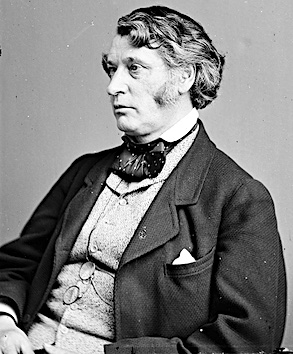 May 22, 2026, is the 170th anniversary of The Caning of Charles Sumner in 1856. After Republican Senator Charles Sumner of Massachusetts gave a speech detailing efforts by pro-Slavery Democrats to force Kansas to become a Slave State he was attacked with a heavy cane in the Senate chamber by Democrat Representative Preston Brooks of South Carolina – whose relative, Senator Andrew Butler, was one of two perpetrators mentioned by Sumner during his speech “The Crime Against Kansas“.
“The senator from South Carolina [Butler] has read many books of chivalry, and believes himself a chivalrous knight with sentiments of honor and courage. Of course he has chosen a mistress to whom he has made his vows, and who, though ugly to others, is always lovely to him; though polluted in the sight of the world, is chaste in his sight — I mean the harlot, slavery. For her his tongue is always profuse in words. Let her be impeached in character, or any proposition made to shut her out from the extension of her wantonness, and no extravagance of manner or hardihood of assertion is then too great for this senator.”
During his speech Senator Sumner succinctly summarized the Democrats’ goal to expand Slavery and how they did it::
“Such was the object. And this could not be, except by the entire prostration of all the safeguards of Human Rights.
The liberty of speech, which is the very breath of a Republic;
the press, which is the terror of wrong-doers;
the bar [judicial system], through which the oppressed beards the arrogance of law;
the jury, by which right is vindicated;
all these must be struck down,while officers are provided, in all places, ready to be the tools of this tyranny;
and then to obtain final assurance that their crime was secure, the whole Usurpation, stretching over the Territory, must be fastened and riveted by legislative bolts, spikes, and screws, so as to defy all effort at change through the ordinary forms of law.
To this work, in its various parts, were bent the subtlest energies; and never, from Tubal Cain to this hour, was any fabric forged with more desperate skill and completeness.”
Senator Sumner’s injuries at the hand of Democrat Preston Brooks were so severe that it took over three years for Sumner to resume his senatorial duties, and even then he never fully recovered from his injuries. In the meantime, the Democrat Party and the Whig Party lost badly during the elections of 1854-1855, giving rise to the “Opposition Party” of ex-Whigs who were opposed to Slavery and which eventually grew into the Republican Party.
And some historians argue that the Missouri’s invasion of Kansas Territory – known as the “Battle of Kansas”, “Bloody Kansas”, and the “Border War” – set the stage for the Southern Democrats seceding from the Union and starting the Civil War.
Senator Sumner’s speech “The Crime Against Kansas” is a passionate, eloquent, well-reasoned, and fact-laden speech, and I recommend it to anyone wishing to learn how even over 100 years ago a political party would use every means at their disposal to obtain their ultimate goals. Click the link above to view the actual document, or click here to download a modern version of the document.
Thanks for Reading!