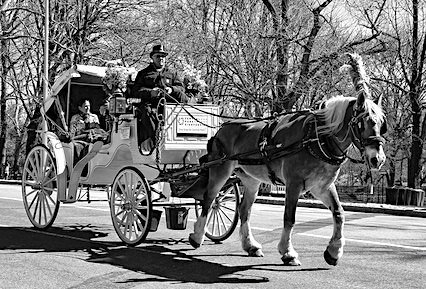
 (Image by Bruce Emmerling, courtesy of Pixabay)
On June 19, 2026, an 18-year old teenager on vacation in New York City with his family from India was was killed during an iconic Central Park tour carriage after the horse bucked and ran away from its’ driver.
According to the victim’s father, after his wife fell out of the moving carriage his son jumped from the still-moving carriage to help her, and in doing so suffered a fatal head injury.
| It was the FIRST known passenger death caused by a Central Park horse-drawn carriage in Central Park’s 168-year history (when the carriage rides started). |
Following that accidental and very unfortunate death, NYC’s Muslim Progressive nascent mayor, Zohran Mamdani, and his City Council Speaker (and Jewish “fledgling foil”) Julie Menin immediately proposed banning the horse-drawn carriage rides through the city’s Central Park starting in 2028, ending a tradition after 170 years, with Menin stating to the NY Post that “the status quo is no longer acceptable”.
Exactly five months later, on November 19, 2026, NYC’s Democratic Socialist Muslim Mayor signed a bill banning the Horse-drawn Carriage Industry. Ironically, on same day recognized by the United Nations as World Toilet Day, and the anniversary of the Jonestown Massacre, where 900 devoted followers of a cult leader committed mass suicide by drinking poison.
At this point it’s probably putting the cart before the horse, but let’s put Julie Menin’s “Status Quo” into perspective:
Since 1982 – a span of 44 years – Central Park’s horse-drawn carriage industry suffered 128 accidents, 30 horse deaths, and now one passenger death (Source).
There are nearly 300 carriage drivers who drive 68 licensed carriages using more than 100 horses which are housed in three stables on Manhattan’s West Side. The drivers are represented by Transport Workers Union Local 100, which states the horses are so well cared for, and their job stress so low, that they’re actually more stressful during their yearly 5-week vacation on a farm.
Note as of January 15th, 2026 the NY Times reports there are 170 Unionized drivers working 68 licensed carriages drawn by 200 licensed horses. However, one must consider the accuracy of NY Times reporting.
A carriage ride currently costs about $78 for the first 20 minutes.
Now let’s do some back-of-the-envelope math:
- After a daily commute of 1.5 miles to Central Park in traffic each carriage travels along 6 miles of roads throughout the Park, where automobile traffic was banned completely in 2018. Each carriage then commutes home.
- Each carriage is drawn by a horse traveling at 3-5 mph during its’ tour of the Park, which translates to 1-1.67 miles during a typical 20-minute ride.
- Under New York City law horses can’t be on the job more than 9 hours per day, and let’s assume the horses are only moving the carriage about 50% of the time (due to consumer demand and/or resting the horse). So, they’re only moving about 4.5 hours a day.
- Let’s also assume a 10-month tour season (ie: no operating during extreme Winter or Summer weather), and each carriage driver takes a 2-week vacation during the year (so, up to 66 carriages working at any time).
The result? Those horse carriages travel between 249,477 and 416,631 miles traveled per season… or, 10,977,010 and 18,331,606 total miles driven since 1982. And the actual number is probably higher.
The 128 accidents from those horse-drawn carriages pales in comparison to accidents, injuries, and deaths caused the Big Apple’s automobiles: Every year since 2013 there’s been approx. 40,000 motor vehicle accidents in NYC resulting in injury or death, with approx. 250 passenger or pedestrian deaths per year from automobiles.
And, at least nine of those deaths took place along the route between one of the horse stables and Central Park.
| 3,250 deaths from vehicles in NYC over the past 13 years compared to ONE known death from horse-drawn carriages over the past 168 years. |
But what’s even worse is the average number of murders and homicides in NYC from 1982 to the present: As documented by the left-leaning Wikipedia, since 1982 there’s been 39,211 murders in New York City, at an average of 891 per year. Those deaths make that one unfortunate carriage death statistically insignificant.
| 39,211 murders in New York City over the past 44 years, compared to ONE known death from horse-drawn carriages over the past 168 years. |
Those carriage horses are housed at two major stables, each in Hell’s Kitchen on Manhattan’s West Side: The Clinton Stables on W52nd between 11th and 12th Avenues, and at a stable on W38th Street between 10th and 11th Avenue in New York City’s West Side. One stable is cooperatively owned, the remaining ones (there are more than two) are each privately owned.
Despite statements by the Union, stables owners, and horse owners that the horses are humanely treated, and City regulations requiring health & sanitary inspections, activists claim the horses are maltreated and abused, and for years have demanded an end to horse use in the city.
Bottom line?
It seems New York City’s Socialist Mayor wants to shut down a small iconic tourist industry in business for 168 years, consisting of a number of independent small business owners who are protected by a Union and whose horses are housed in stables located in one of Manhattan’s most desirable real estate markets.
Curiously, it’s the same mayor who wants to make housing in New York City more affordable.
Sounds like when it comes to shoveling Manhattan manure the City’s stable owners have been replaced by true professionals: Democrat politicians.
Thanks for Reading!
FYI: “Back-of-the-Envelope” Calculation:
- (10 months * 4 weeks * 7 days) * ((9 hour day * 0.5 utilization rate) * 60 minutes per hour) / 20 mins per ride) * (66 carriages) = 249,477 carriage tours during the season.
- At 1 to 1.67 miles per trip depending on the horse’s speed = between 249,477 and 416,631 traveled miles per season.
- Since 1982 (44 seasons) the carriages have driven a total distance of between 10,977,010 and 18,331,6065 miles.
- Assuming just two passengers per ride that’s (249,477 * 44 * 2) = 21,953,976 passengers carried.
- It’s only a rough estimate: While there are more drivers than carriages some carriages may be unavailable due to maintenance or repair.
Interesting Thought: Muslims consider dogs and pigs unclean, and pork meat haram (forbidden), with some Imams believing horse meat is halal (acceptable, when properly killed), makrush (discouraged), or haram (forbidden). Might this have also influenced the decision by Muslim Mayor Mamdani?