“The policy of dollar diplomacy is one that appeals alike to idealistic humanitarian sentiments, to dictates of sound policy, and strategy, and to legitimate commercial aims.”
– William Howard Taft
President Trump’s preferred strategy of “Dollar Diplomacy” has provided America with trillions in future revenue from business deals with numerous foreign countries, strengthened military & economic ties with the Middle East, helped defuse at least 6 active or potential military conflicts, and worked to reduce China’s grip as the World’s manufacturer of consumer goods.
And that’s all very good.
“You can do a lot with diplomacy, but with diplomacy backed up by force you can get a lot more done.”
– Kofi Annan
Indeed, dollars may be dandy, but Might is sometimes right:
President Thomas Jefferson sent the US Navy to fight the Barbary Pirates, James Monroe’s use of “gunboat diplomacy” brought the Western Hemisphere into America’s geopolitical and economic spheres of influence, Ronald Reagan exercised his motto “Peace Through Strength” as he defeated the Communists, while Barack Hussein Obama & Joe Biden’s “Lead from Behind” foreign policy strategy favoring appeasement over intervention destabilized the Middle East, marginalized Israel, and further enabled Iran’s exportation of terrorism and march towards developing Nuclear Weapons.
As for Trump, after conducting Operation Midnight Hammer in June, 2025 which destroyed three of Iran’s largest Nuclear processing facilities, warning Iran not to slaughter their protesters, sending the USS Abraham Lincoln and her support group to the region, sending a second aircraft carrier group to the region, and then warning Iran to come to an agreement on controlling their Nuclear program, President Trump finally launched Operation Epic Fury on February 28, 2026, designed to eliminate Iran’s military and nuclear capabilities, dismantle their terrorist infrastructure, and, if possible, allow Iran’s citizens to determine their own form of government.
In just 31 days the US Military attacked over 13,000 targets in Iran, destroying 1,500 or more air defense locations, at least 450 ballistic missile storage facilities, 800 drone storage sites, 150 Iranian naval ships, over 50% of the IRGC’s small attack boats, stopped 1,700 incoming missiles and drones and conducted 700 strikes on Iranian naval mines.
That’s 80% of Iran’s air defense systems, 90% of Iran’s regular navy, and 95% of Iran’s naval mines reportedly wiped out.
And now we’re getting a lot more done… or, are we?
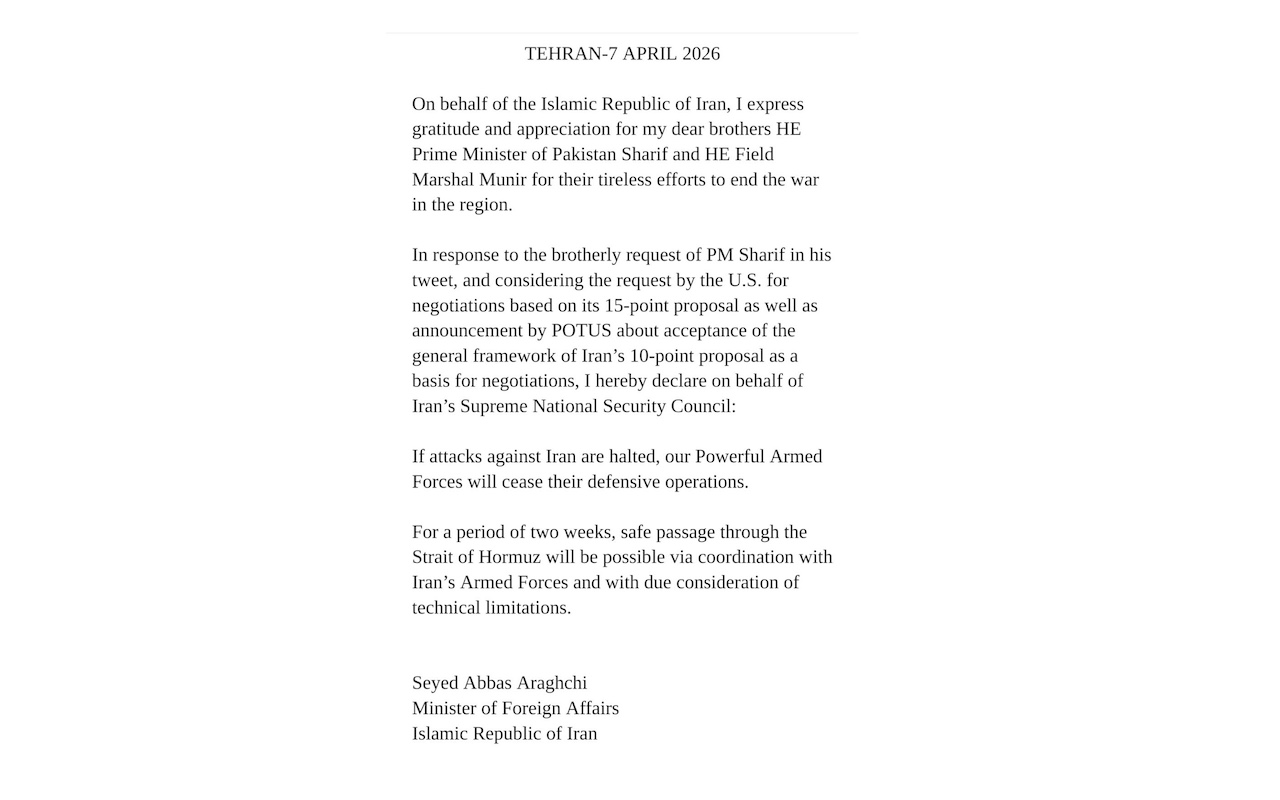
On April 7th, 2026, Iran’s Foreign Minister Seyed Abbas Araghchi, an experienced diplomat and a member of Iran’s nuclear negotiation team, issued a “Statement on behalf of the Supreme National Security Council of the Islamic Republic of Iran”.
Read his official letter below, then click the image to highlight the important portions.
Finally, click the image one more time to read between the lines:
|
“The principle of give and take is the principle of diplomacy – give one and take ten.”
– Mark Twain
It seems this principle of “give-and-take” is embodied in Iran’s 10-point Peace Proposal:
•A halt to hostilities across all fronts, including in Lebanon
•Withdrawal of US troops from the region
•A US commitment to avoid any future military action
•Compensation for losses suffered during the conflict
•Recognition of Iran’s right to enrich uranium (including for weapons use?)
•End to UN Security Council resolutions against Iran (there are 15 resolutions).
•End to the IAEA Board of Governors resolutions (there are 20of them)
•Removal of all primary sanctions (here are just some)
•Removal of all secondary sanctions
•Iran continues to control the Strait of Hormuz
•A toll, payable to Iran, to safely pass through the Strait
•Iran to share toll revenue with Oman
•Iran will use toll revenue to rebuild (does that include rebuilding their military?)
•A UN Security Council Resolution recognizing all these conditions
In short, Iran will be paid for war damages, be free of any restrictions on their economy, assets, or uranium enrichment, collect a toll for ships to use the Strait of Hormuz, won’t have to worry about the United States or Israel attacking them or their allies in the future, and members of the UN Security Council must agree to all of these conditions.
Only then will Iran agree to signing a peace deal.
I’m guessing Mark Twain would have been suitable impressed.
Now that you have an appreciation of how “Diplomacy” works, could this really be an honest attempt by Iran to achieve peace in the region? Or just another attempt to buy time to rebuild and expand their military capacity in their on-going effort to obtain Nuclear Weapons, control the Middle East, and achieve their goal of destroying Israel and America?
Knowing what Iran has done over the past 47 years as an Islamic State I suspect honesty is not Iran’s policy.
“There are few ironclad rules of diplomacy but to one there is no exception. When an official reports that talks were useful, it can safely be concluded that nothing was accomplished.”
– John Kenneth Galbraith
—————————————————————–
Added Bonus!
Diplomacy in the future, courtesy of the 1960′s Sci-Fi series Star Trek:

(click image to see diplomacy in action)
Thanks for Reading!
(Image is from Season 3, Episode 16, “The Mark of Gideon”, Air date 17 Jan 1969)